Saudi Zakat is one of the most important compliance areas for Saudi-owned and Saudi/GCC-shareholding businesses in the Kingdom. While many taxpayers know the standard 2.5% Zakat concept, the actual filing is not based on a simple profit figure alone. In practice, the Zakat liability depends on the Zakat base, which is calculated by adding specific funding-source items and deducting only those assets that qualify under the regulations.\
Key Point:
Saudi Zakat base is not just profit. It is a regulated calculation built on:
- prescribed items added to the base,
- prescribed items deducted from the base,
- special rules for liabilities, and
- minimum base testing before final Zakat is computed.
What is Saudi Zakat?
Saudi Zakat is the religiously based levy applied under the Saudi Zakat regulations to the Zakatable portion of a business. For legal-account taxpayers, the Zakat base is calculated under the ZATCA rules, and the Zakat is generally charged at 2.5% for a Hijri year. Where the entity follows a Gregorian financial year, the rate is prorated based on the actual number of days in the fiscal year over 354 Hijri days.
How is the Zakat Base Calculated?
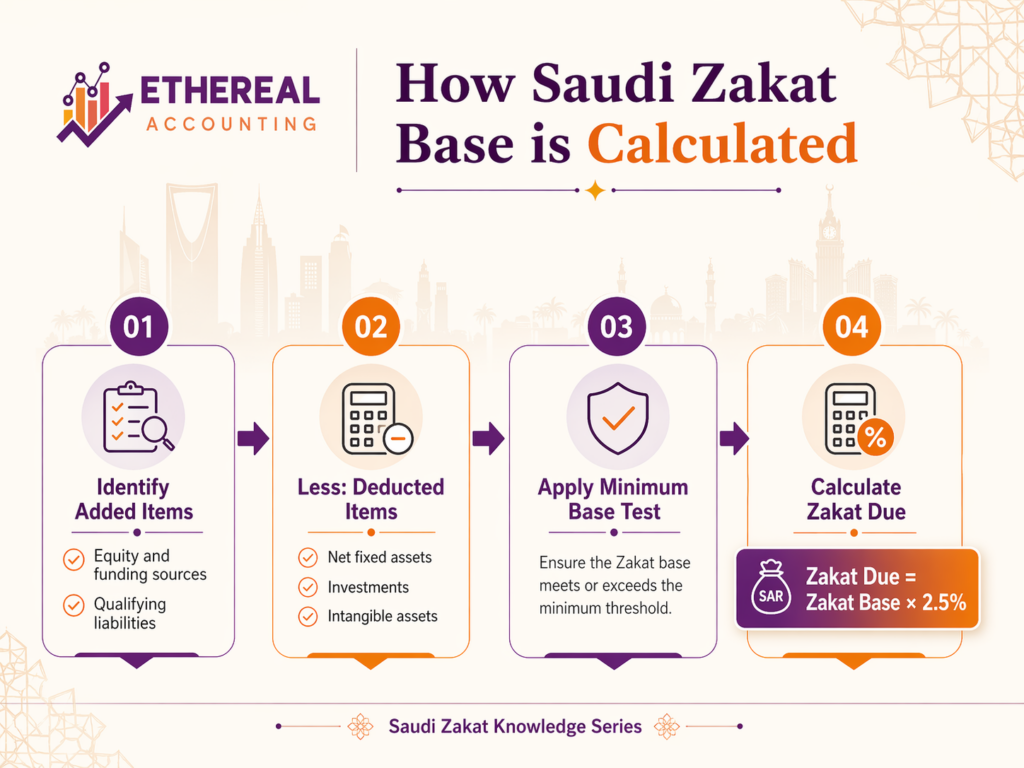
For taxpayers maintaining legal accounts, the Zakat base is determined by:
- adding the items prescribed in Article 23, and
- deducting the items prescribed in Article 26,
subject to the minimum and maximum base rules in Articles 27 and 28. In simple terms, the Zakat base reflects the business’s funding sources after allowing only specific regulatory deductions.
Simple Formula
Zakat Base = Added Items − Deducted Items
Zakat Due = Zakat Base × Applicable Zakat Rate
This looks simple on paper, but the classification of assets, liabilities, and profit adjustments is what makes Saudi Zakat technical in practice.
Main Items Added to the Zakat Base
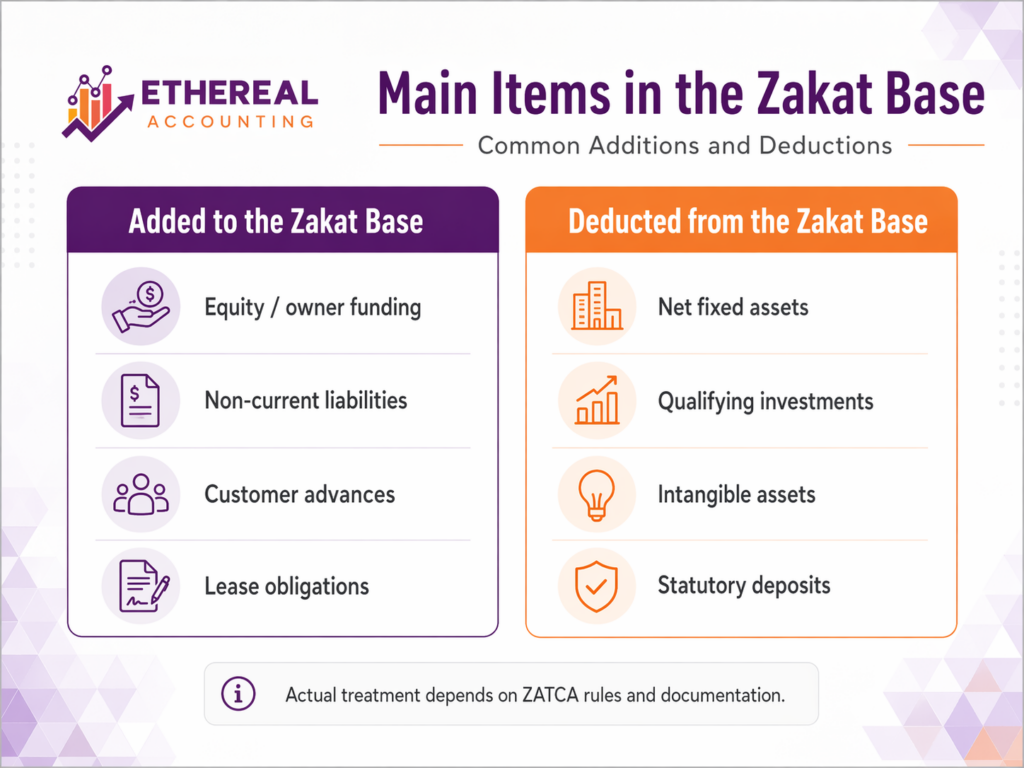
The Zakat regulations require certain items to be added to the base, especially those representing sources of funds. Broadly, the key items include:
- property rights and equivalents,
- qualifying liabilities,
- and certain differences arising from adjusted net profit and book profit treatment.
Under Article 29, common liability-related items that may be added include:
- non-current liabilities,
- long-term loans,
- advance payments from customers,
- issued instruments,
- certain provisions,
- deferred tax liabilities,
- contract obligations, and
- lease obligations.
Main Items Deducted from the Zakat Base
Under Article 26, the main deductible items may include, subject to conditions:
- investment in an enterprise within the Kingdom,
- investment in a facility outside the Kingdom,
- investment in qualifying investment funds,
- net fixed assets,
- intangible assets,
- certain raw materials and materials not intended for sale,
- certain registered financing fund investments,
- certain deeds and bonds treated as capital for the issuer,
- statutory deposits, and
- deferred tax assets.
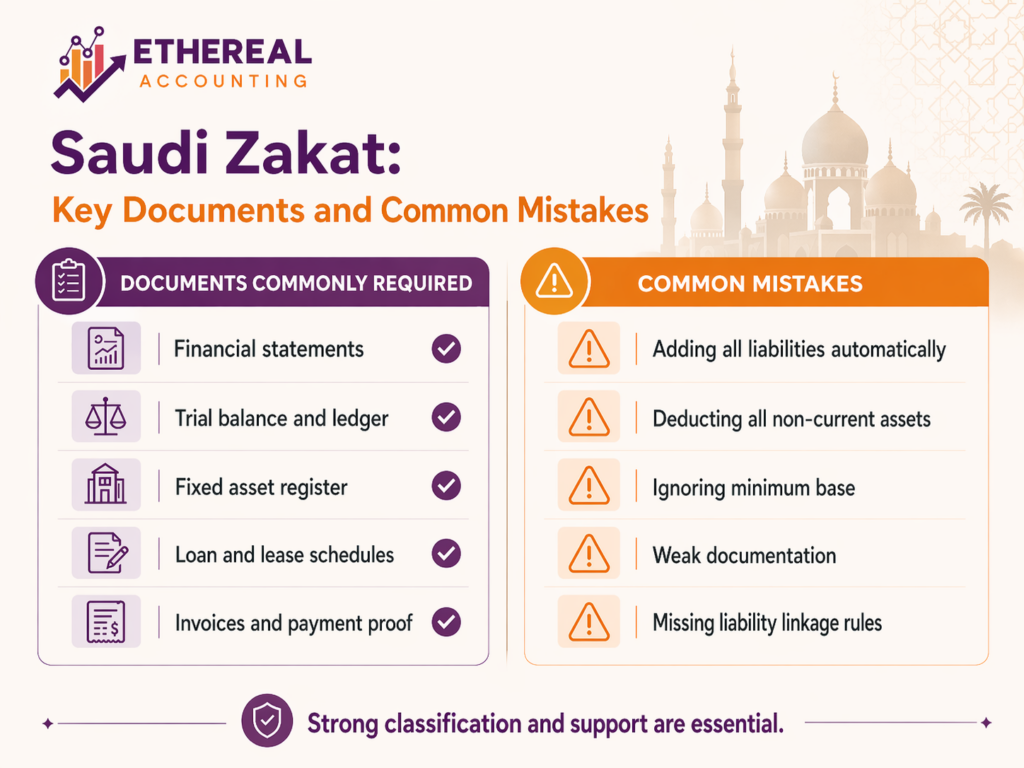
This means that deductions are not automatic. The taxpayer must be able to support both the classification and the conditions for deduction.
Important Note on Liabilities
A common mistake is assuming that all liabilities in the balance sheet should be added to the Zakat base. That is not correct. ZATCA’s regulations and guidance make it clear that only liabilities meeting the regulatory conditions are added. The additions guideline also illustrates that items such as long-term loans, lease obligations, and customer advances may be addable depending on classification and linkage to deducted assets.
Treatment of Current Liabilities
Current liabilities are not always added in full. Under the regulations, current liabilities are added only in limited situations, including where:
- a current asset has been deducted from the Zakat base,
- a traded liability exceeds the traded asset, or
- a current liability is effectively a renewed or rescheduled non-current liability for the same purpose and creditor.
Article 25 also introduces a matching concept. If a current asset is deducted, then a proportion of current liabilities may need to be added back. ZATCA’s guideline even gives a practical example showing proportionate addition where a deducted current asset forms part of total current assets.
Minimum Zakat Base
The regulations also contain a minimum Zakat base rule. This is important because a taxpayer cannot always reduce the base freely through deductions. If the computed Zakat base falls below the required threshold under Article 27, the base may effectively move toward adjusted net profit or another minimum-base result under the regulations.
In practical terms, a correct Saudi Zakat computation must always test the ordinary base calculation against the minimum base rule.
Conclusion
Saudi Zakat is not just a percentage-based compliance. It is a structured calculation driven by the Zakat regulations, financial statement classification, and documentation quality. A proper Zakat computation requires careful identification of what should be added, what can be deducted, how liabilities should be treated, and whether the result satisfies the minimum base requirement.
Need Help with Saudi Zakat?
At Ethereal Accounting, we help businesses review financial statements, classify Zakat items correctly, calculate the Zakat base, and prepare filings with a practical and compliance-focused approach.
Contact us today for support with:
- Saudi Zakat review
- Zakat base calculation
- Financial statement classification
- ZATCA filing support